SEC Quorum Rule: A Commission of One, Adopted Without Public Comment
James McRitchie, 09/30/2026
On September 30, 2026, the SEC changed who gets to decide things at the SEC. It did not propose the change. It didn’t ask for comments. It simply adopted a final rule, effective on publication, that lets a single Commissioner act as the entire Commission whenever every other Commissioner is disqualified from a matter.
Congress created a five-member, bipartisan Commission. The SEC has now decided, on its own and without public input, that one person can be enough.
In California, where I once headed rulemaking at a state agency, we called rules adopted without going through the required process “underground regulations.” The federal version has a different name, but the problem is the same: the public was shut out of a decision that affects everyone the SEC regulates.
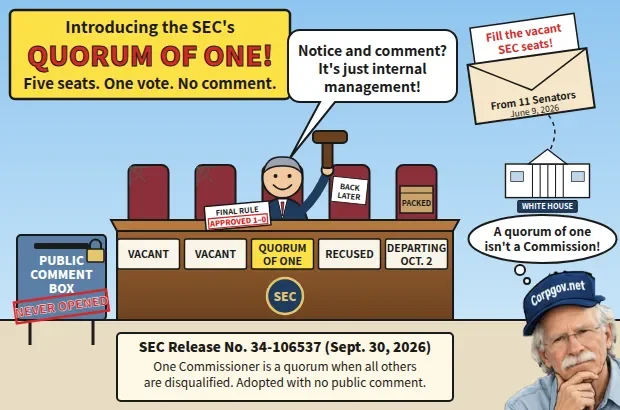
A Quorum of One – and Music for a Democratic Corporate Governance
What the SEC Did
The amendment (Release No. 34-106537) rewrites 17 CFR 200.41, the Commission’s quorum rule. Since 1995, three Commissioners have made a quorum. If fewer were in office, the number in office did. If disqualifications left two able to act, two could. But in 1995, the Commission expressly declined to go further, saying it did not believe it necessary to let one Commissioner constitute a quorum.
The new rule does exactly that. And the stated purpose is not internal housekeeping. The release says the amendment is “designed to promote flexibility and finality of agency rulemaking.”
Yet the SEC skipped notice and comment by calling it a rule of “agency management and organization” that does “not substantially affect the rights or obligations of non-agency parties.” A rule designed to make it easier to finalize rules that bind investors, companies, and markets does not fit that description.
Why the Timing Matters
No Democratic Commissioner has served since early 2026.
Two seats have remained vacant, although nothing prevents the President from nominating, and the Senate from confirming, Democrats to fill them.
Commissioner Hester Peirce has reportedly announced her departure effective October 2, 2026, two days after this rule was adopted.
If no successor is confirmed, two Commissioners will remain, both of the same party. Under the new rule, whenever one is disqualified, the other can act alone for the Commission.
I do not assume how any Commissioner would use this power. The problem is structural. Powers Congress gave to a bipartisan commission could be exercised by one person.
A Quorum of One Is Not a Commission
A quorum is the minimum number of members needed for a body to act. It is plural by definition. One person cannot deliberate with himself.
The D.C. Circuit upheld the SEC’s existing rule in Falcon Trading Group v. SEC (1996), when only two Commissioners were in office. But the court relied on the common-law rule that “a majority of a quorum constituted of a simple majority of a collective body” may act. One Commissioner ia not a simple majority or two and one acting alone is not a collective body. Falcon does not bless this.
Even the Commissioners Say Bipartisanship Matters
On June 9, 2026, Senators Raphael Warnock and Chris Van Hollen, joined by Banking Committee Ranking Member Elizabeth Warren and eight other Democratic senators, wrote to the White House urging it to fill the vacant seats. “A full slate of commissioners and board members can bring a range of perspectives to policies that shape our markets,” they wrote. “No practical barrier prevents the President from next appointing a Democrat to the SEC.” They noted Chairman Atkins has said he is “supportive of having a full complement of commissioners, as it helps with debates and everything else.”
Commissioners themselves have said the same:
Commissioner Mark Uyeda (2022): “The Commission is structurally designed to promote regulation that is the product of consideration by five individuals with different perspectives.”
Commissioner Daniel Gallagher (2013): “Congress created the SEC as a bipartisan, five-member Commission and gave each Commissioner — including the Chairman — only one vote.”
Commissioners Peirce, Crenshaw, and Uyeda, jointly (2025): “Although as Commissioners we approached policy issues from different perspectives, there was always dignity in our differences.”
A quorum of one eliminates the different perspectives they valued.
What’s at Stake for Shareholders
The SEC has proposed rescinding Rule 14a-8, ending the federal requirement that companies include qualifying shareholder proposals in their proxy statements, a right investors have relied on since 1942. Under the new quorum rule, a final rule of that consequence could be adopted by a single Commissioner if the others were disqualified.
Rules that reverse decades of settled policy are exactly where deliberation matters most. A major rule adopted by one Commissioner, or by members of one party alone, may also be more vulnerable to challenge and to reversal by a future Commission. That undercuts the very “finality” the SEC says it wants.
The answer to vacancies is to fill them. It is not to redefine the Commission so that one member can act for all five.
Media Coverage
What I’ve Done, and What You Can Do
Because the SEC didn’t open a comment period, I filed a petition for rulemaking under Rule 192 of the SEC’s Rules of Practice, asking the Commission to rescind the amendment, or at a minimum, suspend it and put it out for public comment. You can read it here: [Comment on Release No. 34-106537]. I also filed a copy in the Rule 14a-8 rescission file (S7-2026-32), because the quorum rule bears directly on who may adopt a final rule there.
My petition also asks the SEC to:
limit any single-member authority to ministerial or time-critical matters, excluding rulemaking, enforcement authorizations, and contested adjudications;
define “otherwise disqualified” and publicly disclose every disqualification that produces a one- or two-member quorum; and
defer final action on major rulemakings, including the Rule 14a-8 rescission, until the Commission has at least three members, including at least one not of the majority party.
You can help:
Support the petition. Once the SEC posts it on its petitions page, file a comment. Until then, email your views to rule-comments@sec.gov, referencing Release No. 34-106537.
Raise it in the Rule 14a-8 file. If you’re commenting on the proposed rescission (S7-2026-32, due November 20), ask the SEC not to finalize it with fewer than three Commissioners.
Contact the Senate Banking Committee. Call (202) 224-7391 and tell them you support their call to fill the vacant seats, which both Republicans and Democrats supported in their letter of June 9, 2026.
The SEC’s legitimacy rests on the deliberation Congress built into it. A Commission of one isn’t what Congress designed, and it isn’t what investors deserve.
Sources
SEC, Commission Quorum Requirement, Release No. 34-106537 (Sept. 30, 2026).
SEC, Establishment of Commission Quorum Requirement, Release No. 34-35548 (1995).
Letter from Sens. Warnock, Van Hollen, et al. (June 9, 2026).
Falcon Trading Group v. SEC, 102 F.3d 579 (D.C. Cir. 1996).
Commissioner Uyeda, SEC Speaks remarks (Sept. 9, 2022); Commissioner Gallagher, remarks (Feb. 22, 2013); Statement of Commissioners Peirce, Crenshaw, and Uyeda (Jan. 20, 2025).
Holland & Knight, “Low Tide at the SEC: From Five Commissioners to Two” (July 2026).