The History of SEC rules and Shareholder Proposal Regulation

During the United States’ first century, corporations had small numbers of investors and were largely controlled by shareholders through deliberations and voting that took place at in-person shareholder meetings. As the US economy grew, and corporations had to bring in large amounts of capital from thousands of investors, shareholder meetings went from in-person affairs to being conducted by proxy, and management solicited blanket voting authority based on little or no information. Ownership and control were largely divorced, and corporate abuse of the proxy, which frustrated the free exercise of the voting rights of stockholders, was rampant. Section 14 of the Securities Exchange Act of 1934 addressed this concern by authorizing the SEC to regulate proxy solicitation.

The SEC adopted the predecessor to SEC Rule 14a-8 in 1942, recognizing that shareholders need notice of proposals to be made by fellow shareholders. One court explained that, “the rationale underlying this development was the Commission’s belief that the corporate practice of circulating proxy materials which failed to refer to the fact that a shareholder intended to present a proposal at the annual meeting rendered the solicitation inherently misleading.” SEC Staff reiterated this purpose, explaining that “[t]he Senate Banking and Currency Committee recognized the need to provide not only for disclosure of matters management planned to present, but also for shareholders to be given ‘reasonable opportunity to present their own proposals and views to fellow security holders.”

Thus, SEC Rule 14a-8 advances the overall Securities Exchange Act’s goal of shareholder democracy—a central purpose of the 1934 Act in reaction to weakening shareholder control and increasingly concentrated corporate power in professional managers. Shareholder democracy stands for the principle that, in return for access to the securities exchanges, the law provides that corporations would incur a corresponding duty to give the shareholders fair suffrage. Referring to 14a-8, one recent judicial decision noted that “[t]he Commission enshrined this edict in its regulations, believing that “fair corporate suffrage” required that all shareholders receive notice of such matters when their proxies are solicited.”

How Investors Deploy Shareholder Proposals

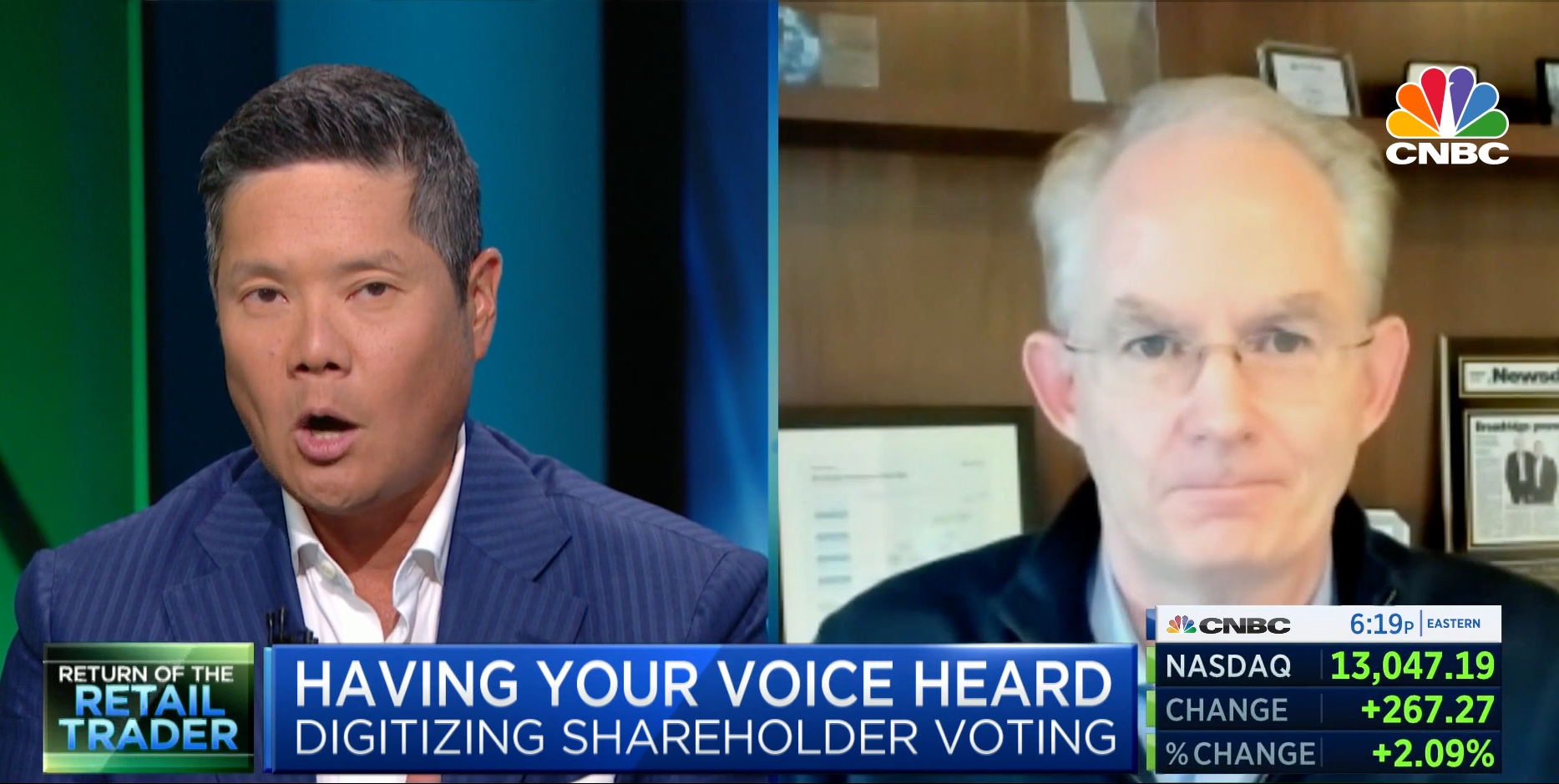
Patrick Miller speaks with Sanford Lewis regarding investors who file shareholder proposals at publicly-traded US companies related to social and environmental issues. They discussed the process for submitting these proposals pursuant to SEC rules.

HOST: Patrick Miller is the Founding Attorney at Impact Advocates APC.

*Disclaimer: The information in these recordings is provided for informational purposes only. You should consult with an attorney before you rely on this information. This information should not be seen as legal advice and does not create an attorney-client relationship. This interview is meant to be a general discussion and may not include all relevant information regarding the issues covered.

Opioids crisis

According to the CDC, opioids were involved in nearly 75,000 overdose deaths in 2023,77 a crisis that continues to ravage communities across the country. The sale and distribution of opioid medications carries significant legal and reputational risks for companies with long-term and systemic societal and economic impacts.

The Investors for Opioid and Pharmaceutical Accountability (IOPA) was a diverse coalition of global institutional investors with 67 members representing over $4.2T in AUM that was established from 2017-2023 to engage opioid manufacturers, distributors and retail pharmacies. IOPA members filed more than a hundred shareholder proposals and took on the most important governance reforms within major pharmaceutical companies to better manage societal and enterprise risks. Central to the IOPA’s strategy was to involve the board in opioid risk management by asking independent directors to investigate and report on how the board is assessing and managing legal, financial and reputational risks related to its opioid business. Fourteen of these companies agreed to conduct board-level risk assessments of opioid-related business practices including governance, compliance, compensation, and political lobbying, and to report these findings publicly. Two companies created a board-level committee dedicated to opioid oversight.


For further information on corporate engagement with health equity issues, see ICCR’s page.

Why Faith Groups Have Historically Practiced Responsible Investing

The full statement can be found on ICCR’s website.

Religious organizations steward their organizational finances and the investments managed on behalf of their constituents and beneficiaries in alignment with the beliefs, teachings, and values of their respective faiths. Many religious organizations develop investment guidelines, which include strategies such as screens to exclude industries that they believe cause injury to society, shareholder engagement with portfolio companies to mitigate environmental and social harm, and investing in companies or projects that are making a direct and positive impact.  This practice, known as faith-consistent investing, is one form of what today is commonly referred to as sustainable and responsible investing. Faith-consistent investing is a fundamental right protected under the First Amendment, which guarantees both free speech and religious freedom, and ensures that investors are able to make their investment decisions in accordance with their beliefs.

The Interfaith Center on Corporate Responsibility (ICCR) is a coalition of over 300 faith and values institutional investors who, for more than 50 years, have been leaders in faith-consistent and sustainable investing. Our genesis as an organization is grounded in the advocacy of multiple faith groups to address the racist apartheid regime in South Africa. Faith-consistent investing leads religious investors to assess how corporate policies and practices may adversely impact the health of people and the planet, which has a direct impact on the long-term performance of their portfolios.

Faith-based investor engagements with portfolio companies, through dialogue and the filing of shareholder proposals, are a natural extension of these beliefs and are central to both our duties as trusted fiduciaries seeking competitive returns and our responsibilities as faithful stewards supporting the fundamental values of our religious traditions. For this reason, we are concerned about any attempts by legislators or policymakers to interfere with investors’ fundamental freedom to make investment choices and/or engage with portfolio companies in alignment with their investment philosophies and institutional values. This includes letters received from the House Judiciary Committee in 2024 by several of ICCR’s faith-based members requesting informational disclosures under the pretense of exploring violations of antitrust laws.

While each faith institution has its own set of priority issues that it addresses through its respective ministries and advocacy work, there are many issues where faith investors’ interests converge. Actions to mitigate the climate crisis ravaging our planet, to uphold human rights, including the fair treatment of workers, and to ensure equitable and affordable access to healthcare are just a few examples of priority issues of common concern among many faiths.  The 2016 Edinburgh Finance Declaration is one example of the world’s leading faiths articulating their shared values. We believe that companies that adopt forward-looking policies and practices to mitigate environmental and social risks are well-positioned for long-term financial success and value creation. Conversely, companies that ignore these risks may endanger the performance of the capital we are called to steward, and impose enduring external costs on society, the economy, and the planet that sustains us. Over the past 50+ years, ICCR member engagements with corporations on these issues have resulted in improved conditions for various stakeholders, including workers, customers, communities, and shareholders. For instance, most of the world’s faiths emphasize stewardship of the planet, care for creation, and moral responsibility toward the environment, which makes them deeply concerned about the climate crisis. Faith investors working in climate-vulnerable communities witness firsthand how climate change adversely affects these areas. Without the adoption of meaningful climate mitigation and adaptation measures, extreme poverty and inequality, risks to land, food and water security, forced migration and geopolitical conflict, along with global health risks, will all intensify. Consequently, faith investors often align with other like-minded investors to tackle climate risk and advocate for a reduction of GHG emissions from our portfolio companies. Faith-based investors actively promote worker justice, which includes workplace health and safety protections, the provision of a living wage, and the freedom to associate and engage in collective bargaining. Faith-based investors have advocated for health equity, engaging with the world’s largest healthcare companies to ensure that medicines and healthcare services are affordable and accessible reaching those most in need.

Importantly, while we often cooperate in investor spaces around strategies to spur corporate action, we make independent investment decisions to provide risk-adjusted returns to our individual constituents and beneficiaries in line with our respective faith beliefs. The U.S. Constitution provides that “Congress shall make no law respecting an establishment of religion or prohibiting the free exercise thereof,” and the First Amendment protects the religious liberty that is foundational to this great nation. This ban against government interference in faith-consistent practices is essential when considering all aspects of the life and work of religious institutions, including their investment decisions.  It preserves their autonomy to invest their organizational assets and the pensions of their millions of beneficiaries in a manner consistent with their religious beliefs.  In recognition of the constitutional limits of entanglement between the federal government and religious institutions, Congress included a Church plan exemption in the Employee Retirement Income Security Act of 1974 (ERISA).

We want to reiterate our belief that companies committed to addressing their impacts on society and the environment are better positioned for financial success over the long term. For this reason and because our faith calls us to do so, we will continue to invest and engage with our portfolio companies to realize that goal.

Governance Proposals

Governance proposals and the role of individual investors

Governance engagements seek to ensure that a well-functioning board can effectively oversee the interests of shareholders. For example, proposals to increase the independence of the audit or risk committee have the potential to reduce accounting fraud risk. Likewise, engagements to increase the holding period of equity-based pay reduce management incentives to manipulate short-term earnings.

Governance shareholder proposals can also increase investors’ ability to engage with companies. It has been shown that it is more costly for investors to engage with companies with entrenched managers.14 The entrenchment of management is principally measured and affected by the corporate governance infrastructure including whether the company has characteristics such as:

  • Staggered boards ƒ  

  • Limits to shareholder by-law amendments

  • Supermajority requirements for mergers ƒ  

  • Supermajority requirements for charter amendments ƒ  

  • Poison pills ƒ  

  • Golden parachutes

Shareholder proposals that improve corporate governance structures on these aspects are frequently part of an overall strategy by investors to provide a better balance of power between investors and a company’s management and board.

S&P Global Market Intelligence: SEC proposed rule would have blocked 614 ESG resolutions since 2010, data shows 

Author: Esther Whieldon

Since 2010 more than 600 environmental, social and governance-related resolutions likely would have never advanced under a newly proposed rule by the U.S. Securities and Exchange Commission, according to data the Sustainable Investments Institute shared with S&P Global Market Intelligence.

The SEC in November 2019 proposed to increase the amount of support a shareholder resolution required to be reconsidered in the years following an initial vote. Rather than resolutions needing at least 3% support the first year, 6% the second year, and 10% the third and subsequent years after an initial vote to be reconsidered, the SEC would raise those thresholds to 5%, 15% and 25%, respectively. The agency estimated the changes would cut the number of shareholder proposals by 7%.

While the rule has yet to be finalized, the Sustainable Investments Institute, or Si2, compiled a database of ESG resolutions voted on from the beginning of 2010 through Nov. 18, 2019. Si2 found that 614 ESG-related resolutions, or about 30%, of the 2,019 proposals voted on at company annual meetings over that period would not have been eligible for resubmission. That total is almost three times the number of resolutions — 206 resolutions — that could have failed existing threshold requirements over that time, according to Market Intelligence's analysis of the data.

Of the 614 potentially impacted resolutions, political activity, climate change and human rights issues would have taken the biggest hit.

Companies are coming under increased pressure from investors to disclose how ESG risks could impact their bottom line, and they are addressing those risks and opportunities. But groups such as the U.S. Chamber of Commerce and Business Roundtable have pushed for reforms to the shareholder resolution process.

Shareholder Rights Group: At Boeing, Wells Fargo, Chevron - SEC Rulemaking Proposals Would Have Blocked Investor Engagement on Critical Issues

Immediate Release
January 7, 2019


The Shareholder Rights Group (SRG), a coalition of investors who exercise their right to file shareholder proposals, has written to the Securities and Exchange Commission (SEC) in opposition to proposed rule changes that would effectively undermine the ability of shareholders to continuously promote increased corporate responsibility and improved corporate governance.  [Link to letter] 

Currently, shareholders that own at least $2,000 in stock for one year have the right to engage an investee company on an issue of concern through procedures set forth in the SEC’s Rule 14a-8. In late 2019, the SEC proposed dramatic changes to the Rule, undermining shareholders’ rights to hold companies accountable for risk mitigation and crisis management. In addition to making it harder to file proposals by requiring larger or longer-term holdings, the rulemaking proposal would make it more difficult for shareholders to submit a proposal to a second or third vote by imposing steep voting thresholds – 25% support by the third year, and disallowing a proposal if it suffered a loss of momentum after that. The SRG letter notes that “[i]n practice sometimes 10% or 20% of investors represent the leading edge of an issue - the prescient minority, and therefore it is not wise for the management to discount the topic they are surfacing.” 

The SRG’s letter highlights three case studies in which shareholders preemptively sought disclosure or oversight of certain issues that have proven to be significant concerns for those companies. Specifically, the SRG’s letter explains how the proposed rule changes, if they had been in effect at the time of shareholder engagement, would have interfered with investors’ ability to directly respond to recent corporate responsibility crises and controversial operations at Boeing, Wells Fargo, and Chevron. 

Boeing: Prior to the two crashes of Boeing’s 737 Max airliners in 2018 and 2019, shareholders had encouraged better disclosure of Boeing’s notoriously aggressive lobbying policies, expenditures, and internal controls. Under the SEC’s proposed rulemaking on resubmissions, shareholder proposals on lobbying would have been barred beginning in 2017 – shortly before the 737 Max crashes. Yet, after the 737 Max crashes, shareholders supported lobbying disclosure with 32.6% of the vote in 2019. Had the proposed resubmission thresholds already been in place, shareholders would have been denied an opportunity to address this matter with the company in the wake of these catastrophic events.

Wells Fargo: Wells Fargo has suffered and continues to suffer a prolonged crisis of public, government, and consumer trust, having paid over $17.2 billion in penalties since 2000. The establishment of 3.5 million fictitious or unauthorized accounts, and improper practices in which 800,000 people were forced to take redundant auto insurance from 2012 to 2017, have punctuated an era of predatory practices. Had the SEC’s proposed resubmission thresholds been in place, shareholder proposals concerned about the ethical and business risks of predatory lending would have been excludable from 2013 to 2016. Additionally, under the SEC’s proposed threshold changes, shareholder proposals seeking an independent board chair would not have been permitted from 2013 to 2016 – a change that the company quickly enacted after its 2016 account fraud scandal. The failings of leadership, toxic corporate culture, and misdirected incentives have cost at least $24 billion in market value, despite early prescient shareholder engagement.

Chevron: In the U.S., advancement on corporate climate change mitigation initiatives has been driven to a large degree by shareholder proposals and shareholder engagement. One informative example is the progression of hydraulic fracturing and methane proposals at Chevron. Shareholder engagement from 2011-2015 had led to significant advancement of Chevron’s environmental practices and reporting; during this timeframe, shareholder support ebbed and flowed reaching highs of 40% (inspiring corporate action) and dipping to 26% before rebounding to over 30%. In 2018, approximately 45% of Chevron’s shareholders voted in favor of a shareholder proposal related to fugitive methane reduction, which again inspired a corporate response on the issue. However, had the SEC’s newly-proposed “momentum requirement” been in place, this natural variation of shareholder support would have meant that investors would not have been offered the opportunity to vote on that 2018 proposal that they resoundingly supported. 

Sanford Lewis, Director of the Shareholder Rights Group explains in the letter that “[i]n our assessment, the SEC’s proposed proxy rule changes would disrupt functional working relationships between shareholder proponents, institutional investors, and proxy advisors and companies. The proposed rule changes would make the path of investor engagement steeper and more convoluted, adding unnecessary costs and red tape, and making it more difficult for investors to foster sustainability, risk management, and governance improvements at their companies. It would block the most established and effective path for improving environmental, social, and governance (ESG) disclosure and performance of the market.”

The Shareholder Rights Group urges all concerned investors to write to the SEC in opposition to the proposed rules by the February 3 comment deadline. Additional info on the proposed rule changes, including links to the proposed rules are included at InvestorRightsForum.com

The SEC is accepting comments on the proposed rules until February 3, 2020. Write to:  Vanessa A. Countryman, Secretary, U.S. Securities and Exchange Commission, 100 F Street NE, Washington, DC 20549-1090; Email to: rule-comments@sec.gov. Email or hard copy subject line should include reference to the File No. S7-23-19 (shareholder proposals) and File No. S7-22-19 (proxy advisors).

Business Roundtable Must Defend Shareholder Access to Proxy

Business Roundtable Must Defend Shareholder Access to Proxy

We write today for two reasons. The first is to commend the Business Roundtable (BRT) and the 181 CEOs who endorsed the new Statement on the Purpose of the Corporation(the “Statement”), embracing the importance of companies’ commitment to key stakeholders. The statement acknowledges a central tenet of ICCR’s core philosophy: that companies focused on the well-being of all their key stakeholders and not just on boosting short-term shareholder returns will be more successful over the long term. A growing community of ESG investors have been supportive of companies demonstrating leadership in corporate responsibility for years, with the firm belief that these companies are building long-term value for shareholders.We expect the BRT CEO statement will stimulate an important dialogue within companies,investors and the broader public.

However,the principles clearly articulated in the Statement makes the BRT’s continuing lobbying and public statements against shareholder resolutions dealing with environmental, social and governance issues even more perplexing. We urge the BRT to reassess its campaign against shareholder resolutions in light of the new statement.

We read with interest the June 3,2019 BRT letter to the Securities & Exchange Commission (SEC Letter)and take issue with several of the assumptions used to support the BRT’s argument. The BRT’s characterization of the issues raised in the proxy process, as well as the motivations of shareholder proponents, is a simplistic description that is false and misleading.

Read More

Investor Voice: SEC’s Proposed Rule Changes Muzzle Shareholders and Shield CEOs From Accountability

“The shareholder proposal rule is the bedrock of effective corporate engagement in the United States,” said Bruce Herbert, chief executive of Investor Voice.  “For over 70 years, the shareholder engagement process has been a vital tool for stockowners to propose good ideas involving sustainability, profitability, and governance; to hold CEOs accountable for mismanagement; and to mitigate risk by addressing issues like climate change and human rights.” 

Read More

NY State Comptroller DiNapoli Statement on Proposed SEC Rule Changes

"The SEC's proposals are two of the most significant actions to restrict shareholder rights in the SEC’s history. There is no credible evidence to support the need for these proposals, and if adopted, they would undermine corporate accountability, entrench managements’ opposition to shareholder proposals and increase costs for investors. These proposals are contrary to the SEC's mission to protect investors and our financial markets. Along with other investors, I will continue to voice my opposition to these actions and my support for greater corporate accountability."

Read More

New York City Comptroller Scott M. Stringer on Proposed SEC Rule Changes

"The proposed U.S. Securities and Exchange Commission changes will compromise the independence of our contracted proxy advisers, impose limits on shareowner proposals and therefore further insulate corporate management from accountability to shareowners. If implemented, these actions would be a shameful gift to corporate executives at the expense of shareowners.”

Read More

Council of Institutional Investors: Fact Sheet on Proxy Advisory Firms and Shareholder Proposals Nov. 5, 2019

Most public companies do not receive any shareholder proposals. On average, 13% of Russell 3000 companies received a shareholder proposal in a particular year between 2004 and 2017. In other words, the average Russell 3000 company can expect to receive a proposal once every 7.7 years. For companies that receive a proposal, the median number of proposals is one per year.

Read More

AS YOU SOW: As Shareholder Support for Climate Change and other Environmental, Social, and Governance Issues Grows, SEC Votes to Restrict Shareholder Voice

“The SEC has been unable to point to any demonstrable problem with the current shareholder system or make a case for how its proposal to limit shareholder rights will improve company value,” said Danielle Fugere, president of As You Sow. “To the contrary, this proposed rulemaking has the potential to increase shareholder and company risk, particularly regarding growing climate concerns. We don’t believe that it will withstand public or legal scrutiny.” 

Read More

Linking Investor Engagement with Financial Value

 Linking Investor Engagement with Financial Value

Julie Gorte, Impax Asset Management

Some observers tend to see vote totals on shareholder proposals as binary — either they pass or they don’t. But it is useful to understand the nuances, too. In accounting, a shareholder holding at least 20 percent of a company’s shares has a significant or active interest, and that is something that can influence management decisions. That provides a different lens through which to see the 30 percent average support for shareholder proposals than a simple pass/no pass view. It’s also an indicator that it’s not just a bunch of frustrated political activists interested in these proposals; it’s an indication that a significant proportion of a company’s investors see them as relevant to the company’s financial performance.

Read More

Investor Coalition Fights Opioids Crisis

By LAURA E. WEISS, CQ

Screenshot 2019-07-24 08.23.03.jpg

It began as a suggestion from a county health official to leaders of a group of nuns’ money management program. They were addressing climate change, modern-day slavery and immigration — why not the opioid epidemic?

A year and a half later, the mammoth coalition of investors born from that idea wields $2.2 trillion of influence, urging the largest U.S. drug companies to take accountability for playing a role in the opioid crisis. The group, Investors for Opioid Accountability, has cut deals with companies in the business of making or distributing opioid painkillers to review how they oversee sales of the highly addictive drugs and make other corporate governance changes aimed at improving supervision of opioid sales.

“No one is untouched by the opioid crisis in the country — or even globally now as it’s beginning to turn out — but we lead with the investor lens because that is our responsibility and our duty to give an investor voice to it,” says IOA co-leader Meredith Miller. She says the coalition”s 46 members — including state treasurers, public pension funds, faith-based investors and union benefit funds — are hearing from their ministries, citizens or union members about the crisis.

***

IOA’s shareholder proposals include requests for reports on board oversight of risks related to opioid sales, mechanisms for recouping executive pay in the case of misconduct, disclosure of lobbying spending, independent board leadership and other adjustments to oversight mechanisms and how the CEO and other top leaders are paid.

***

IOA has claimed several victories so far. The coalition’s opioid risk report proposal won support from 62 percent of investors in Assertio Therapeutics Inc., which makes opioid painkiller Nucynta. The same proposal neared majority approval at AmerisourceBergen Corp., one of the “big three” U.S. drug wholesalers. IOA says it has a commitment from another large distributor, Cardinal Health Inc., to publish risk reports, recoup executive pay in cases of misconduct and split the roles of CEO and board chair. McKesson, the country’s sixth-largest company, and several manufacturers have also agreed to changes including reviews of how directors oversee opioid sales, avoiding votes on IOA’s proposals.

Read more